

Flight Lesson Expectations for New Pilots
- Lumina Aviation

- Jul 3
- 6 min read
Your first flight lesson rarely feels the way people imagine it. It is usually less like an adrenaline event and more like the beginning of a disciplined process. That is why clear flight lesson expectations matter. When you know what a lesson is designed to accomplish, what your instructor is evaluating, and why some days feel slower than others, training becomes far less intimidating and much more productive.
For most new students, the biggest surprise is that progress in aviation is not measured by how quickly you get airborne. Real progress comes from judgment, consistency, and understanding what is happening before, during, and after the flight. A well-run lesson is structured, calm, and purposeful. You should expect to be challenged, but not rushed.
What flight lesson expectations should look like
A professional flight lesson begins before the engine starts. You are not simply showing up to ride along while an instructor demonstrates maneuvers. You are entering a training environment where safety, preparation, and decision-making are part of every phase.
That usually starts with a preflight briefing. Your instructor will explain the plan for the day, review the lesson objective, and connect it to your stage of training. On an early lesson, that may mean learning cockpit orientation, basic aerodynamics, or how the aircraft responds to control inputs. Later, it may involve takeoffs and landings, navigation, emergency procedures, or scenario-based decision-making.
This briefing matters because flight training is cumulative. Each lesson should build on the last one. If an instructor cannot explain why you are practicing something and how it fits the larger path, the lesson may feel busy without being effective.
You should also expect honesty about conditions. Some days the weather supports a strong training session. Some days it does not. A safety-first operation does not force a lesson into marginal conditions just to keep the schedule moving. That can be frustrating in the moment, but it reflects the kind of judgment you want to learn from.
The first part of the lesson is often on the ground
New students sometimes expect most of the lesson time to be spent in the air. In reality, some of the most valuable instruction happens before taxi and after shutdown.
You may spend time reviewing weather, aircraft documents, airport procedures, airspace, and checklist flow. You will likely walk around the aircraft with your instructor and learn how to conduct a preflight inspection. This is not a formality. It is your first introduction to the idea that pilots are responsible for evaluating the aircraft, the environment, and the risks before every flight.
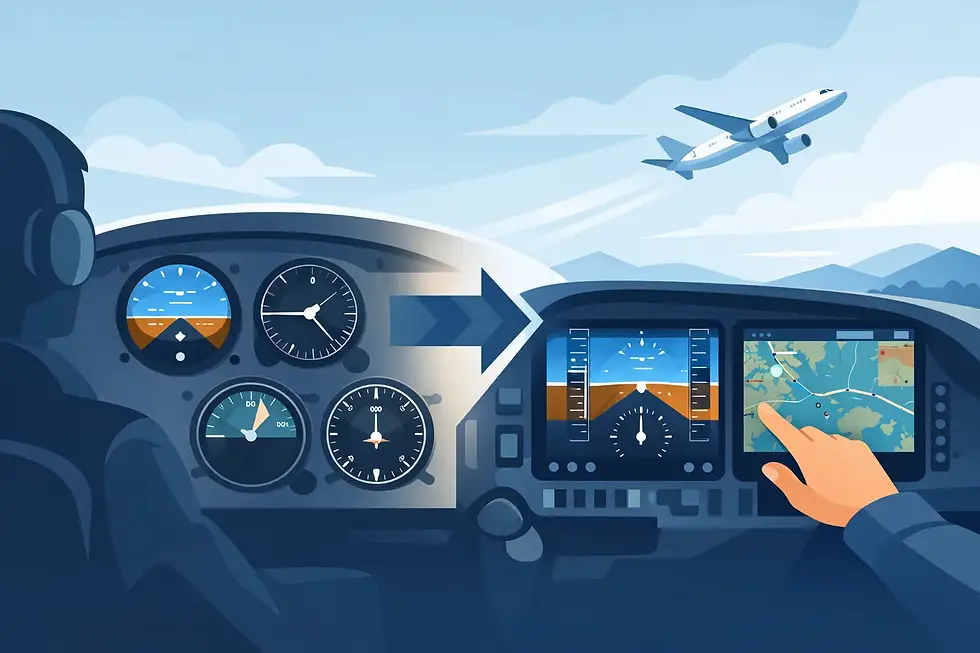
In a modern training aircraft with a glass cockpit, there is also a learning curve with avionics. New students often assume advanced displays make everything easier right away. They can improve situational awareness, but only if you learn to use them with discipline. Early on, your instructor may keep your focus on outside references and basic control while gradually introducing cockpit systems. That balance is deliberate.
What to expect once you are in the air
The first minutes after takeoff are usually where nerves either rise or settle. Most students relax once the aircraft is established in flight and they realize they are not expected to perform perfectly.
Your instructor will likely demonstrate first, then guide you through a task. You may practice straight-and-level flight, climbs, descents, turns, and basic coordination. If it is an introductory lesson, you may also get time on the controls simply to feel how the aircraft responds. If you are already in a training program, the lesson will be more structured around a specific objective.
This is where many students need a mindset adjustment. A good flight lesson is not a performance test every minute. It is a coached environment. You will make imperfect control inputs. You may overcorrect. You may miss an altitude or drift off heading. That is normal. The point is not to avoid all mistakes. The point is to recognize them, correct them, and build consistency.
At the same time, you should expect professionalism. Your instructor should maintain clear standards, communicate directly, and intervene when needed. Calm instruction is not passive instruction. A strong instructor creates enough room for you to learn while preserving margins at all times.
Flight lesson expectations change as you progress
What feels normal on lesson one will not be enough by lesson twenty. Expectations should increase as your skills develop.
Early training is about orientation and basic aircraft control. Soon after, the emphasis shifts toward procedures, traffic pattern work, radio communication, and landing consistency. Later, your instructor will expect stronger situational awareness, better checklist discipline, and more independent decision-making.
That progression can feel uneven. You may have a week where everything clicks, followed by a lesson where landings feel worse than before. Aviation training is rarely linear. Fatigue, weather, wind conditions, lesson spacing, and even stress outside the cockpit can affect performance. The right expectation is not constant perfection. It is steady development over time.
That is one reason standardization matters. When training is conducted with consistent methods and clear benchmarks, it is easier to understand whether you are truly progressing or just having a strong day. Serious flight schools build training around repeatable standards because confidence should come from competence, not guesswork.
What your instructor expects from you
Students often focus on what they should expect from the school, but the relationship works both ways. Your instructor will expect preparation, attention, and a willingness to learn.
Preparation does not mean arriving with expert knowledge. It means showing up on time, ready to focus, and having reviewed any assigned material. If you are consistently unprepared, lessons become less efficient and more expensive. If you come in ready to engage, even short flights can produce strong results.
You should also expect to speak up. If you do not understand a concept, ask. If you feel overloaded in the cockpit, say so. If a maneuver is not making sense, your instructor needs that feedback. Good training is not built on pretending to understand.
Aviation also rewards humility. Students who improve fastest are usually not the ones trying to impress anyone. They are the ones willing to be corrected, willing to repeat fundamentals, and willing to slow down enough to do things the right way.
Common concerns and what is actually normal
Many first-time students worry that they will feel sick, freeze on the radios, or fall behind if they do not learn quickly. Those concerns are common, and most are manageable.
Mild sensory overload is normal in early lessons because there is a lot to absorb. The cockpit introduces new sounds, procedures, and scan habits. That does not mean you are unsuited for training. It usually means your brain is doing the work of building a new framework.
Radio work also feels difficult at first because it combines listening, timing, phraseology, and situational awareness. Most students do not sound polished early on. They improve through repetition and context, not through pressure.
Cost and pacing are another major concern. Some students expect every lesson to move at the same speed, but weather delays, maintenance scheduling, and skill plateaus are real parts of aviation. The better expectation is transparency. You should understand what you are paying for, what the lesson goal is, and what needs to happen next to stay on a clear path.
How to get more from every lesson
The students who build momentum usually treat each lesson as part of a larger system. They review notes afterward, chair-fly procedures between flights, and keep training frequency consistent when possible. Even one extra hour of thoughtful preparation on the ground can make the next flight more effective.
It also helps to judge your lesson by the quality of learning, not by the excitement level. Some flights feel dramatic. Others involve repetitive work in the pattern or detailed preflight review. The quieter lessons often produce the strongest long-term gains because they tighten habits and sharpen judgment.
If you are training in a modern, well-maintained aircraft with current avionics, use that environment to build habits that will serve you later. Learn not just where to tap on a screen, but how to manage information, avoid fixation, and maintain aircraft control while using cockpit technology responsibly. That is the kind of discipline that carries forward.
At a school like Lumina Aviation, that emphasis on calm structure, standardized instruction, and modern equipment is not cosmetic. It shapes the kind of pilot you become.
The best expectation to bring into any flight lesson is simple: you are there to learn a serious craft, one deliberate step at a time. If your training environment is thoughtful, safety-centered, and honest about the process, you do not need to force progress. You need to stay engaged, keep showing up, and let disciplined repetition do its work.


Comments